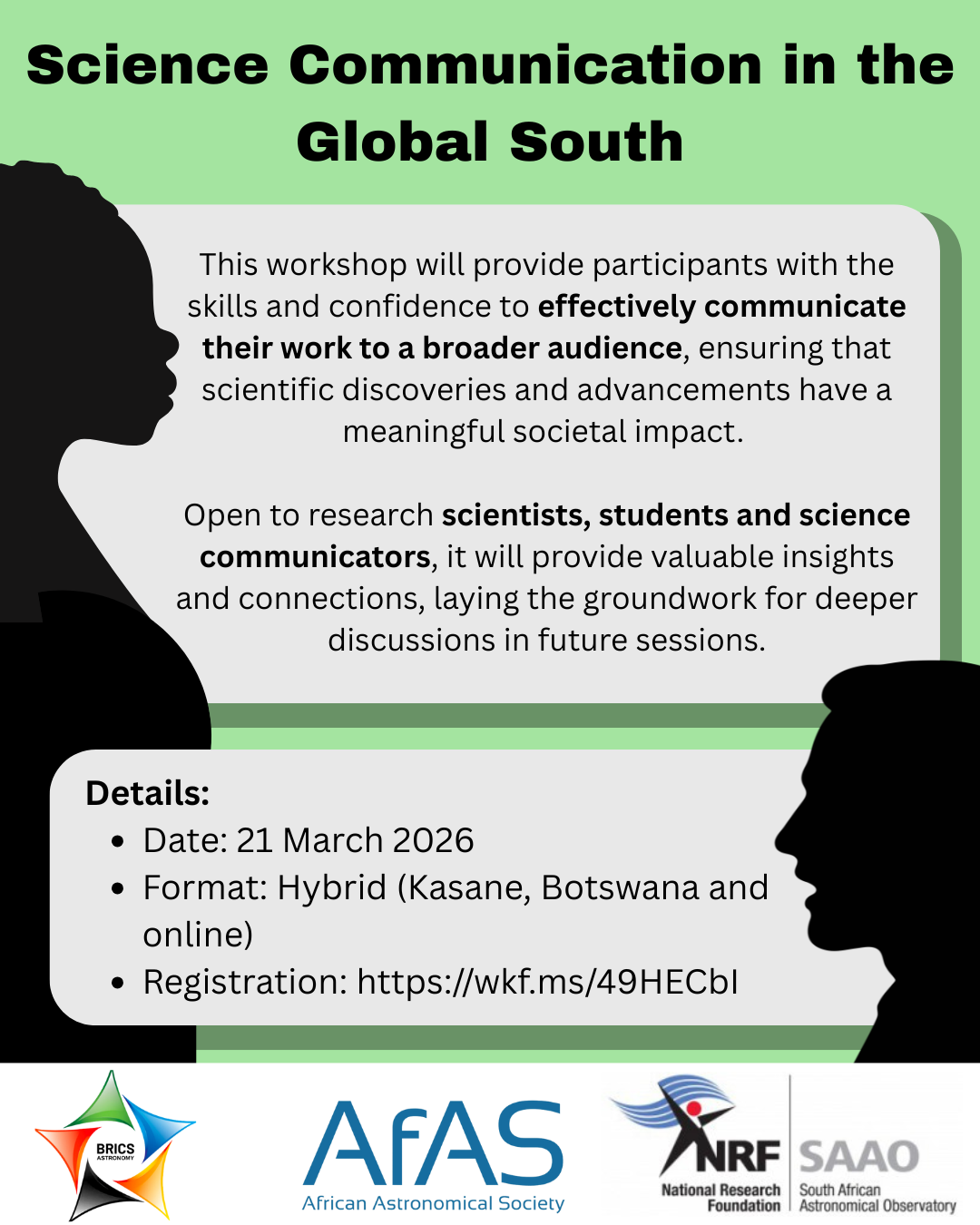
Science Communication in the Global South: Communicating Astronomy 101
This program is designed to equip researchers, students, professionals, and science communicators in astronomy and other basic sciences across BRICS and African countries with essential skills in science communication. The initiative aims to strengthen participants’ ability to effectively convey scientific knowledge, engage the public, and inspire greater interest in astronomy, basic sciences, and all the sciences.
The workshop will feature expert speakers or trainers with academic and practical experience in relevant topics. The program also seeks to bridge the gap between academia and practice, addressing the current divide in science communication.
Key features of the program:
- Equip researchers with practical skills in science communication and public engagement with science.
- Foster collaboration between BRICS and the African astronomy community under a shared vision of public engagement and inclusion.
- Strengthen science communication capacity across the Global South through coordinated training and mentoring programs.
- Encourage participants to develop outreach initiatives across different segments of society and serve as ambassadors for astronomy within their communities and regions.
We invite researchers, students, professionals, and science communicators in astronomy and other basic sciences across BRICS and African countries to join the training workshop.
Workshop themes:
- Overview of science engagement – its importance and impact
- Science communication and media engagement
- Policymakers and policy-making, and how to communicate with this group
Overview of science engagement – its importance and impact – TBC
This segment will explore the role and significance of science engagement, examining perspectives from diverse countries and regions. Participants will gain insights into why science communication matters, its various applications, and its broader societal impact.
Key discussion points:
- Why science communication? Understanding its purpose and importance.
- The role of science engagement in fostering public trust, policy influence, and societal impact.
- Policy and strategic frameworks that guide effective science engagement efforts.
Science communication and media engagement – Thembela Mantungwa
The United Nations International Covenant on Economic, Social and Cultural Rights 1966 recognises the importance of access to science as a universal right, saying everyone has a right, “To enjoy the benefits of scientific progress and its applications.” Thus, society should be afforded the right to know and engage with science meaningfully. These are foundations of democratizing science, including the sharing of innovations, technology transfer, and research applications to solve societal challenges such as poverty and unemployment.
Among the most effective ways to communicate science is the media. This session will explore media relations and their role in science communication, providing practical training on engaging the public through press and digital platforms.
Key discussion points:
- Preparing for public and media engagement: Understanding why your research matters and why the public should care.
- Writing an effective press release: What to include, what to leave out, and tailoring content for different audiences.
- Anticipating media responses: Preparing for high engagement or limited responses and ensuring availability once the press release is issued.
- Interview preparation: Presenting research from a public or media-friendly perspective without sensationalizing results.
- Beyond traditional media: Exploring alternative methods to engage the public and expand outreach.
Policymakers and policy-making, and how to communicate with this group – Declan Kirrane
This part of the workshop will focus on how to communicate science in a way that is useful to policymakers, how to build and sustain relationships with the people and institutions that shape decisions, and why this matters for achieving impact. Participants will explore how policy decisions are made in practice, what policymakers need in order to act, and how to translate scientific evidence into clear options, credible messages, and decision-ready asks that align with mandates, budgets, and political realities.
The session will also look at the relationship side of policy influence: how trust is built over time, how to engage advisers and senior officials as well as ministers, how to follow up effectively, and how to stay relevant through policy windows such as strategy renewals, budget cycles, and major multilateral moments. Emphasis will be placed on practical tools – short briefs, two-slide packs, and 60-second messages – and on avoiding common pitfalls such as jargon, overloading with data, or presenting “awareness raising” without a pathway to implementation.
Ultimately, the workshop will highlight why science–policy communication is not an optional extra but a core skill: it enables evidence to shape real-world choices, strengthens accountability and public value, and helps ensure that investments in research and innovation translate into better outcomes for society
Key discussion points:
- What do policymakers actually need to act?
(Not more data – what’s the decision, the options, the trade-offs, and the one clear ask?) - How do we translate science into a message that lands?
(What framing works – economy, risk/resilience, public value, delivery – and what jargon or detail should be removed?) - How do we build influence over time?
(Who are the real gatekeepers – advisers/senior officials – what timing matters, and what follow-up builds trust and momentum?
Why participate?
This workshop will provide participants with the skills and confidence to effectively communicate their work to a broader audience, ensuring that scientific discoveries and advancements have a meaningful societal impact. This workshop is open to research scientists and students looking to enhance their public engagement skills or a science communicator seeking to expand your network. The session will provide valuable insights and connections, laying the groundwork for deeper discussions in future sessions.
- Date: 21 March 2026
- Format: Hybrid (Kasane, Botswana, and online)
Session organisers:
Duduzile Kubheka
Thembela Mantungwa